What Hungarians actually do at Christmas
Hungarian Christmas is a private family evening on 24 December, preceded by St Nicholas on the 6th and St Lucy's Day on the 13th. This guide sets out the customs a visitor will meet, and what stays open once the shops shut.
About the facts in this text: the checked dates and the links to every organiser are on the list of all markets (checked 21 September 2026). Opening hours, prices and programme mentioned in the running text refer to the 2025/26 season or to the state of the organiser's page when this was written — check before you travel.
Mikulás on 6 December
6 December is the feast of St Nicholas. In Hungarian he is called Mikulás. He comes on the night of 5 December, for 6 December. Children clean a boot or shoe and put it in the window; in the morning it holds sweets, chocolate figures, tangerines and nuts. Shops and markets sell chocolate Mikulás figures from mid-November.
Mikulás is accompanied by the Krampusz, a horned figure who deals with badly behaved children. They are left a virgács, a small bundle of golden-painted birch twigs, sold on every street corner in early December. Mikulás does not bring the Christmas presents on the 24th.
Luca napja on 13 December
Luca napja, St Lucy's Day, falls on 13 December. It is the old winter-solstice date in Hungarian folk tradition, associated with witches and fortune-telling. The custom most often mentioned is the Luca-szék, a stool started on 13 December and finished only on Christmas Eve. The same day is used for planting Luca wheat, whose sprouts decorate the Christmas table. Both are household customs, sitting on the calendar between Mikulás and the main celebration on 24 December.
Szaloncukor and the run-up
From November the shops stock szaloncukor: fondant, jelly or marzipan-filled chocolate candy in twisted foil wrappers, hung directly on the Christmas tree as an edible decoration. The custom dates from the mid-19th century. Supermarkets stock dozens of flavours from November.
At the markets the standard hot drink is forralt bor, mulled red or white wine with cloves and cinnamon, usually served in a deposit cup or mug. Punch and hot chocolate are the alcohol-free alternatives. Kürtőskalács, chimney cake, is baked over charcoal and rolled in sugar, cinnamon or walnut.
Szenteste, 24 December
Szenteste, Holy Evening, on 24 December is the main celebration, and it is a private family occasion rather than a public one. The tree is usually decorated on that day and presents are opened in the evening, which is why the city empties out after lunchtime. Presents are traditionally brought not by Mikulás but by Jézuska, the Baby Jesus, sometimes with angels. Children are usually sent out of the room and called back when a bell rings and the tree is lit.
24 December is a half-day under Hungarian shop-opening law. Shops, supermarkets and food markets are legally allowed to trade only until 14:00, after which the city becomes very quiet. Many restaurants also close for the evening because Szenteste is a family occasion.
What is eaten on Christmas Eve
Halászlé, a paprika fish soup made with carp or mixed river fish, is the usual Christmas Eve first course in much of the country, often followed by breaded fried fish or stuffed cabbage. Fish is traditional because 24 December was historically a fasting day. Bejgli is the standard Christmas cake: a rolled yeast pastry filled with ground poppy seed (mákos) or walnut (diós), sliced into rounds. Every pastry shop (cukrászda) sells it through December.
Midnight mass
Midnight mass, éjféli mise, on 24 December is widely attended, including at St Stephen's Basilica and Matthias Church. Both churches are next to Christmas markets. It is a church service, held after the family evening at home.
The two central Christmas markets shorten their hours on the 24th rather than closing. In the 2025/26 season Advent Bazilika ran 11:00–15:00 on 24 December; at Vörösmarty tér the fair ran 10:00–14:00. Hours for 2026 have not been confirmed.
25 and 26 December, and 1 January
25 and 26 December and 1 January are statutory public holidays in Hungary. Under Hungarian shop-opening law most retail shops, supermarkets and food markets must stay closed on those days. The exceptions are small non-stop shops, petrol station convenience stores, florists and shops inside tourist attractions. On 25 and 26 December shopping centres themselves may open, but only their entertainment tenants may trade: cinemas, restaurants, cafés, bars and clubs. The shops inside stay shut. Museums and most state-run attractions close on 24–26 December and 1 January. Thermal baths, the larger hotels and many downtown restaurants aimed at visitors stay open, often with a fixed holiday menu and advance booking required.
The two central Christmas markets shorten their hours rather than closing over the holidays. In the 2025/26 season Advent Bazilika ran 11:00–20:00 on 25–26 December, 11:00–03:00 on 31 December and 11:00–18:00 on 1 January, when it closed for the season. At Vörösmarty tér the fair ran 12:00–18:00 on 25–26 December and 11:00–03:00 on 31 December; the craft stalls and the mini train finished on 28 December, after which the site switched to the New Year's Eve programme. These are 2025/26 dates and hours; 2026 has not been confirmed.
What a visitor can do on those days
On 24 December after 14:00 shops are shut, many restaurants are closed, and public transport runs on reduced holiday timetables, with several lines on a Sunday or holiday pattern. BKK publishes the changes in advance. Midnight mass at St Stephen's Basilica or Matthias Church still takes place. Night services are reinforced on 31 December. On 25 and 26 December the remaining options are thermal baths, hotel and downtown restaurants with a holiday menu (book ahead), and cinemas, cafés, bars and clubs inside shopping centres.
In the 2025/26 season Óbuda and Gozsdu ended on 23 December 2025. The two central markets ran to 31 December 2025 and 1 January 2026. Budavári Advent ran to 4 January 2026, and the City Hall Park market to 10 January 2026, with its ice rink to 31 January 2026. None of these 2026/27 dates had been published when this was written.
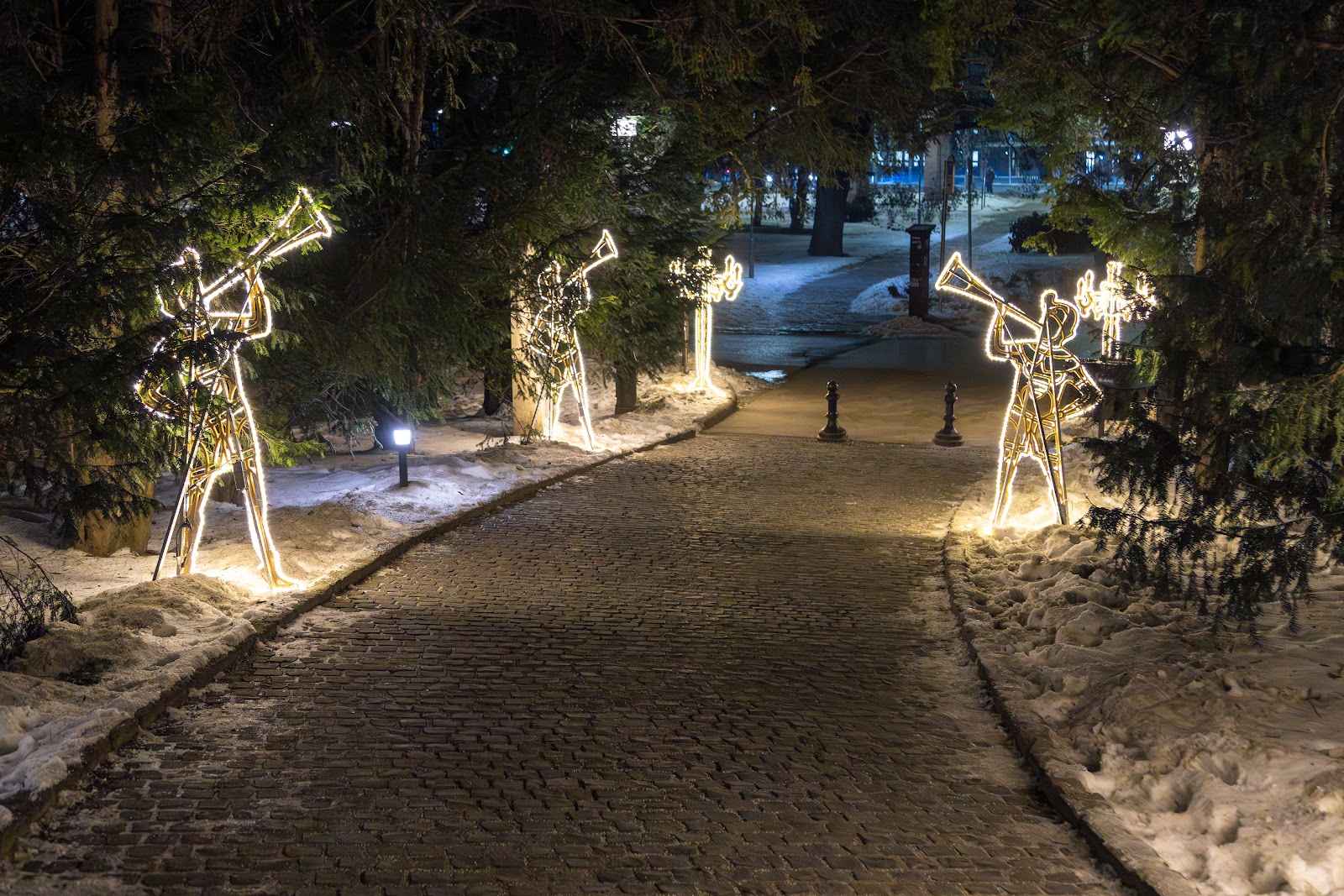
Outside Budapest, Story of Lights Gödöllő, the palace light park run by DECOLED, the publisher of this site, is confirmed for 24 October 2026 to 31 January 2027. It is open daily 18:00–21:00 while summer time lasts and 17:00–21:00 after the clocks change, with last entry at 20:30. It is closed on 1 November and on 24 and 25 December.
Common questions
When do Hungarian families open Christmas presents?
Presents are opened on the evening of 24 December, Szenteste. They are traditionally brought by Jézuska, the Baby Jesus, not by Mikulás, who comes on 6 December.
Do shops open on 24, 25 and 26 December?
On 24 December shops, supermarkets and food markets may trade only until 14:00. 25 and 26 December and 1 January are public holidays, and most retail shops must stay closed, with limited exceptions such as small non-stop shops and petrol station stores.
What is szaloncukor?
Szaloncukor is fondant, jelly or marzipan-filled chocolate candy in twisted foil wrappers, hung on the Christmas tree as an edible decoration. The custom dates from the mid-19th century, and supermarkets stock dozens of flavours from November.
Can visitors attend midnight mass?
Midnight mass on 24 December is widely attended, including at St Stephen's Basilica and Matthias Church, both next to Christmas markets. It is a church service held after the family evening at home.
What stays open on 25 and 26 December?
Thermal baths, larger hotels and many downtown restaurants aimed at visitors stay open, often with a fixed holiday menu and advance booking required. Shopping centres may open, but only entertainment tenants — cinemas, restaurants, cafés, bars and clubs — may trade; the shops inside stay shut. Museums and most state-run attractions close.